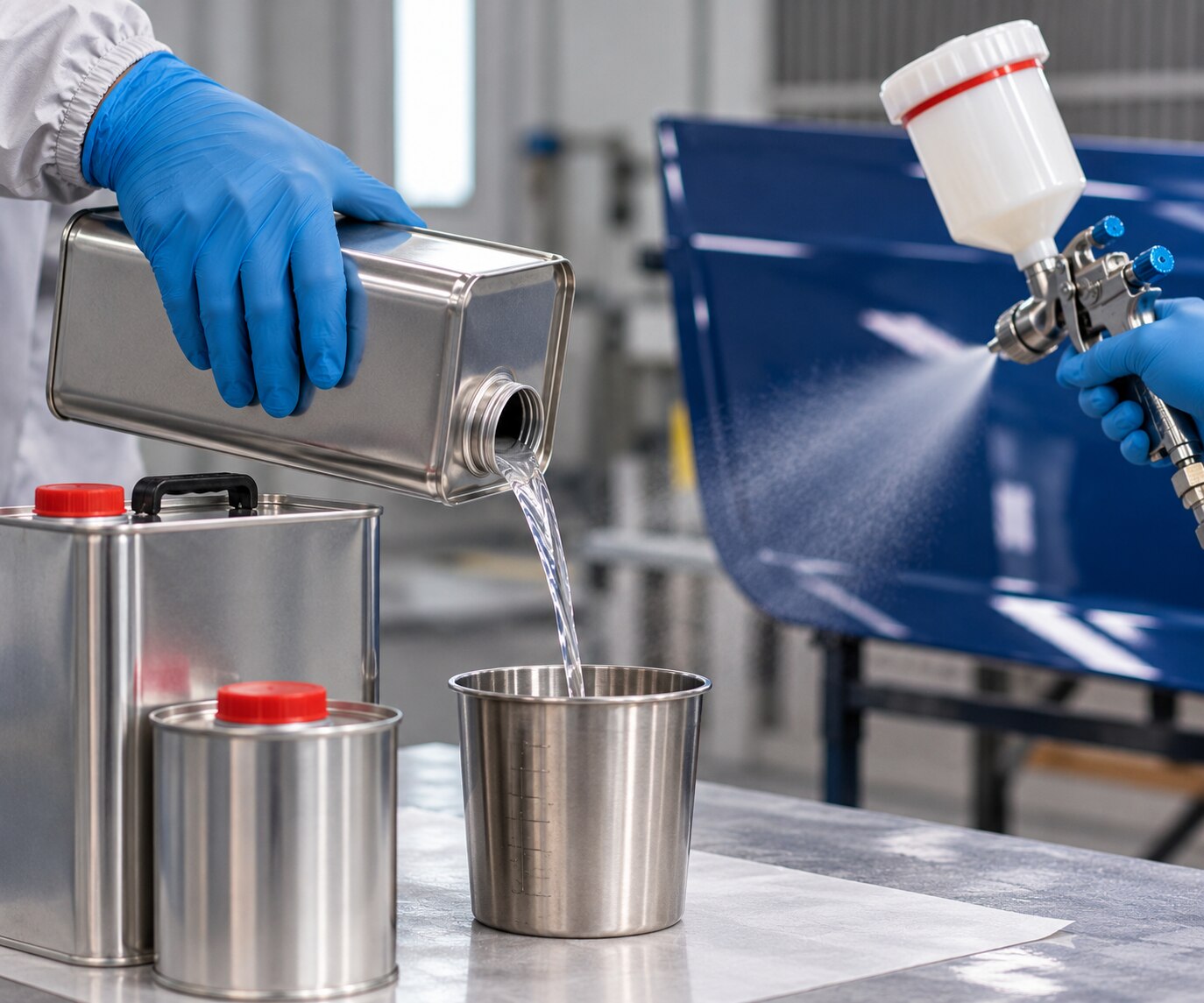
Bangalore’s humidity, rain, surface temperature and ventilation can change flash-off, gloss, adhesion and the risk of blushing even when the air feels warm enough for spraying. By checking dew point, substrate dryness, air movement and coating symptoms, you can adjust timing and thinner grade without using excess solvent.
Key takeaways
- Check panel temperature and dryness before spraying.
- Reduce humidity effects with ventilation and controlled flash-off.
- Change thinner ratio only after ruling out surface moisture.
- Verify batch, technical data and compatibility before use.
Which Bangalore weather conditions change NC thinner application?
Relative humidity and the panel’s temperature change NC thinner application conditions in Bangalore more than air temperature alone. During the southwest monsoon and October–November rains, a panel can stay damp even when the room feels warm. That is the main NC thinner use in Bangalore risk.
| Condition | What changes | Practical control |
|---|---|---|
| Air temperature | Warm air does not prove that the substrate is dry. | Measure the panel, not only room temperature. |
| Relative humidity | Start checking at roughly 75–80% RH; high moisture increases blushing risk. | Follow the lacquer and thinner supplier’s technical data first. |
| Rainfall | Rain leaves moisture on panels, floors and compressed-air lines. | Avoid active rain and spraying immediately afterwards. |
| Surface temperature and dew point | Keep the panel normally about 3 °C above dew point. | If it is at or below dew point, condensation can cause whitening, cloudiness, poor gloss or weak adhesion. |
| Ventilation | Fast solvent evaporation cools a wet film, allowing moisture to condense inside it. | Use controlled cross-ventilation, not a powerful fan aimed at the coating. |
High humidity, a cold panel, fast NC thinner or a heavy wet coat increases blush risk. The film can turn milky, dry unevenly or lose gloss. Excessive direct airflow adds dry spray and uneven evaporation, while insufficient airflow leaves solvent vapour and slows flash-off.
Temperature, humidity, rainfall, surface temperature, dew point and ventilation must be checked together before spraying.
How can you confirm that a panel is dry enough before spraying?
A panel is dry enough when it is visibly dry, above the dew point by about 3 °C, and within the lacquer maker’s humidity limit. Do not judge dryness by touch alone.
- Inspect for condensation, damp patches, water marks, or evidence of recent rain exposure.
- Compare the panel’s feel with the room; a noticeably cold panel can be near condensation even when the air feels comfortable.
- Measure relative humidity with a hygrometer and surface temperature with a surface thermometer. Calculate or read the dew point, then postpone spraying if the panel is at or below it, or lacks the approximate 3 °C margin.
- Check damp wood separately. Wood can hold moisture after the room has dried.
- Drain and test compressed-air lines, filters, and hoses. Wet air can add moisture to a clean panel.
- Confirm that washing water has fully evaporated from seams, edges, and recesses.
Timing changes the decision for NC thinner monsoon Bangalore work:
| Timing | Risk | Decision |
|---|---|---|
| Active rain | Rain-driven humidity and wet surfaces | Do not spray |
| Immediately after rain | Panels and air lines may remain damp | Wait and recheck |
| Early morning or late evening | Surface temperature can approach dew point | Measure before work |
Open controlled ventilation and use dehumidification where available. Avoid a strong fan aimed at the wet film. Wait for the substrate and air supply to dry; extra thinner is not a substitute for proper nc thinner application conditions.
What should you change when using NC thinner in humid weather?
Use the lacquer maker’s stated thinner ratio for NC thinner in humid weather; do not add solvent because the film feels slow. In warm, damp air, choose a compatible medium or slow grade when that lacquer system permits it.
A compatible retarder or slower blend reduces blushing by slowing solvent loss, but it must match the lacquer’s resin, plasticizer and solvent balance.
The practical nc thinner monsoon bangalore decision is to adjust evaporation speed, not dilute the coating further:
- Allow longer flash-off between coats before recoating.
- Apply a lighter, more controlled wet film instead of one heavy coat.
- Maintain controlled cross-ventilation to remove vapour without disturbing the surface.
- Keep strong fans from pointing directly at the wet film; an unbalanced air blast causes uneven evaporation, dry spray and surface skinning.
Replacing all thinner with retarder damages finish quality. Excessive retarder lengthens drying, increases dust pickup, reduces early hardness and traps solvent inside a thick film. Adding extra thinner does not solve slow drying either: over-thinning lowers solids, increases sagging and solvent entrapment, and reduces build and coverage.
Watch the film, not just the clock. If it remains soft or hazy, extend flash-off and check film thickness, substrate dryness and air movement before changing the blend. Use the exact thinner combination specified for that NC lacquer; a formula suitable for one resin system can produce poor flow or weak early hardness in another.
How do you tell a thinner-ratio problem from a humidity problem?
Runs, low build and poor coverage point to excessive thinning or an overly wet coat. Dry spray and orange peel point to fast evaporation, excessive gun distance, poor atomisation or too much air movement.
Whitening, milky haze, sudden loss of gloss or a cloudy film after spraying point to humidity-related blushing, especially with a cold panel, fast NC thinner or a heavy coat. High humidity can cool the wet film as solvent evaporates, allowing moisture to condense into it.
Slow drying and solvent entrapment do not prove that you used too little thinner. High humidity, excessive film thickness and too much retarder can all slow drying. Poor adhesion also demands checks for condensation, damp wood, silicone or oil contamination, and insufficient surface preparation. Contaminated compressed air and wet hoses can create similar defects.
Use this correction sequence for NC thinner application conditions:
- Verify that the substrate is dry and remains about 3 °C above its dew point. Check for damp wood and condensation.
- Check air cleanliness: drain the compressor, inspect filters and confirm that hoses contain no water or oil.
- Check film thickness, spray distance, atomisation and air movement before changing the mix.
- Allow proper flash-off between coats; do not cure a heavy wet film by adding extra thinner.
- Test one adjusted variable on a small panel. Compare a controlled thinner-ratio change with the existing mix before production.
For NC thinner in humid weather, isolate one cause at a time. That prevents a humidity defect from being mistaken for a ratio defect.
How should you choose and verify NC thinner for Bangalore conditions?
NC thinner is a formulation category, not one universal solvent. Products can differ in acetates, ketones, aromatics, alcohols, retarders and evaporation rate. A blend that performs well with one lacquer can cause whitening, wrinkling, poor flow or softening with another.
For nc thinner use in Bangalore weather, compare the lacquer maker’s specification with the supplier’s data before buying. Ask for the recommended thinner grade, mixing ratio, evaporation profile, storage instructions and technical data for that specific lacquer.
| Blend | Main behaviour | Bangalore decision |
|---|---|---|
| Fast grade | Quicker flash-off; greater cooling and blush risk | Use only when the lacquer data permits it and conditions are cool, dry and ventilated |
| Medium grade | Balanced evaporation and flow | Use as the starting comparison for many controlled applications |
| Slow grade or retarded blend | Longer flash-off; reduced rapid solvent loss | Consider in warm, humid conditions when the lacquer maker approves it |
Dharani and Company, a Bengaluru-based NC thinner supplier, can provide product compatibility information, but the lacquer maker’s specification controls the purchase.
Test the proposed combination on a small panel under the expected temperature and humidity. Check flow, gloss, flash-off, hardness and adhesion before production; these are the decisive NC thinner application conditions, not the product name alone.
Keep containers tightly closed and labelled, away from ignition sources, in a cool, ventilated chemical-storage area. Never transfer thinner into a beverage or water container.
Related product
 | NC THINNER As a distinguished NC Thinner manufacturer, we specialize in producing high-quality chemical solutions to cater to a wide range of industrial needs. View product → |
Frequently asked questions
Which Bangalore weather conditions change NC thinner application?
High relative humidity, monsoon dampness, cool panels and poor ventilation slow evaporation and can cause blushing, cloudiness or weak film formation.
How can you confirm that a panel is dry enough before spraying?
Measure the panel temperature, inspect for visible moisture, wipe with a clean dry cloth and wait until the surface remains dry after ventilation.
What should you change when using NC thinner in humid weather?
Improve air movement, avoid spraying onto cold or damp panels, extend flash-off time and follow the coating maker’s thinner ratio.
How do you tell a thinner-ratio problem from a humidity problem?
A ratio problem follows an incorrect mix across conditions; a humidity problem appears mainly on damp, cool or poorly ventilated surfaces.
How should you choose and verify NC thinner for Bangalore conditions?
Match the thinner to the NC coating, confirm its technical data and batch details, then test spray on a small panel before production.
Keywords