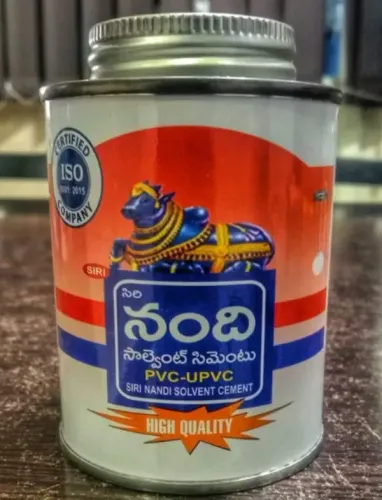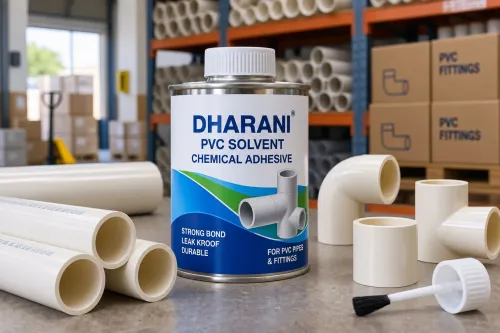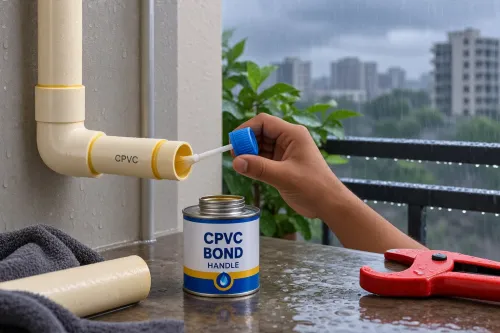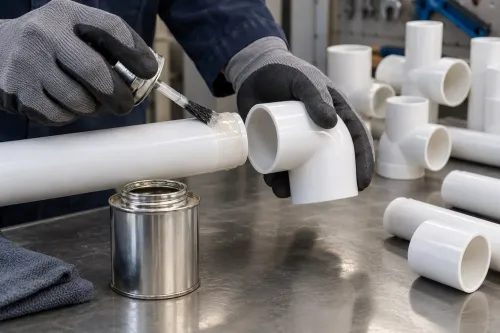
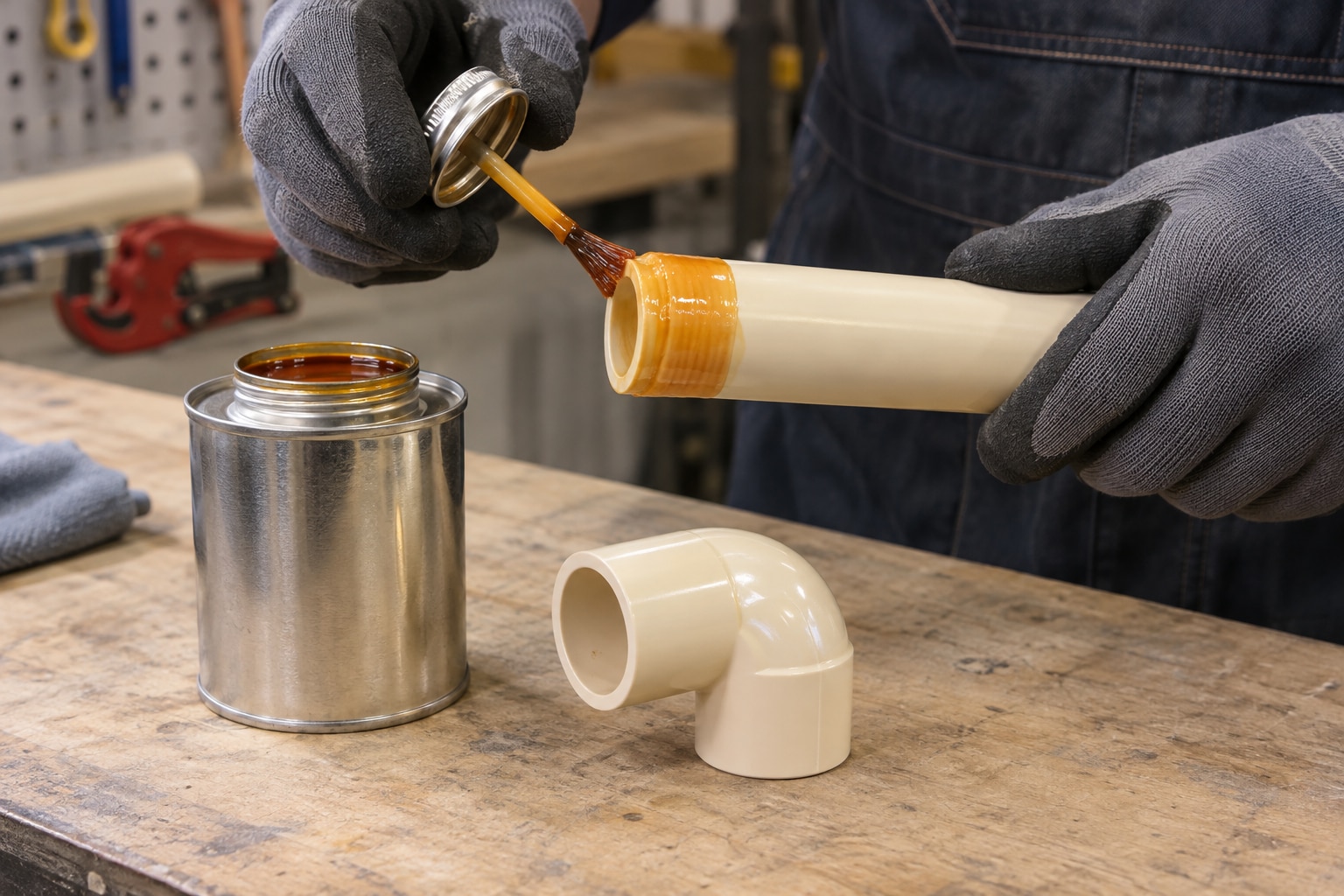
CPVC bond does not simply sit between two plastic parts like ordinary glue: its solvents soften the pipe and fitting surfaces, allowing them to fuse as the solvents leave the joint. By following the preparation, application, curing, testing, and purchasing controls, you can decide whether a bonded joint is ready for service and when another connection method is safer.
Key takeaways
- Cut square, deburr, clean, and dry both CPVC mating surfaces.
- Apply compatible CPVC primer and solvent cement across the socket depth.
- Respect the cement’s cure schedule before pressure testing or service.
- Choose flanges, threads, or mechanical couplings when disassembly is required.
How CPVC Bond Creates a Fused Pipe Joint
CPVC solvent cement does not merely glue a pipe to a fitting. It softens and partially dissolves the mating CPVC surfaces, allowing polymer chains to intermingle across the socket. As the solvent evaporates, the softened zones harden into one fused joint.
The socket must grip the pipe with an interference fit. Cement cannot safely repair a loose, undersized, oval, contaminated, or badly cut pipe; a poor dry fit is a reason to stop and investigate. Water, oil, burrs, cutting debris, or marker residue can block solvent action and leave a leak path.
To confirm that the cement, pipe, and fitting belong to the same system, check each item against the others:
- Read the pipe and fitting markings for CPVC material, nominal size, manufacturer, standard, and pressure class.
- Check that the cement label explicitly lists CPVC compatibility; PVC or UPVC compatibility alone is not enough.
- Match the cement’s approved size range and primer instructions to the pipe manufacturer’s joint procedure.
- Compare the cement documentation with the system’s temperature, pressure, and conveyed chemical requirements.
- Request batch or lot traceability, shelf life, safety data, and any approval named by the project specification.
That is the practical answer to how cpvc bond works in industrial pipe assembly bangalore: treat cement, pipe, and fitting as one engineered system, not interchangeable products. A cement that bonds CPVC can still fail when its residue or the plastic is attacked by the process fluid.
The CPVC Pipe Bonding Process from Cut to Assembly
A square cut starts the CPVC pipe bonding process. Measure the required length, cut the pipe square to its axis, and reject any end that is crushed, oval, or contaminated with oil or cutting debris. Solvent cement cannot correct a loose or distorted interference fit.
- Remove burrs from the inside and outside edges. Chamfer the pipe end evenly so it enters the socket without scraping cement away.
- Clean and dry the pipe end and fitting socket. Use only a cleaner compatible with CPVC, and let it evaporate completely. Water, dirt, marker ink, or excess shavings can block solvent action.
- Insert the dry pipe fully into the fitting without cement. It should require firm insertion and show no loose movement. Mark the insertion depth, then confirm the pipe marking, nominal size, pressure class, fitting material, and manufacturer instructions match.
- Select an applicator sized for the joint and apply the specified CPVC cement to the pipe and socket. The cement label must explicitly list CPVC compatibility; PVC or UPVC compatibility alone does not establish suitability.
- Assemble immediately, pushing the pipe straight to full depth. Rotate it about one-quarter to one-half turn during insertion if the system instructions permit it, then align the fitting and hold the joint against push-out.
- Keep the cement container closed, control ignition sources, ventilate the area, and wear chemical-resistant gloves and eye protection. Allow the stated cure period before pressure testing or service.
Cure, Inspection, Testing, and Rework Before Service
A firm-feeling joint is not proof of full cure. Release it only against the cement manufacturer’s cure table, which accounts for pipe diameter, joint tightness, cement type, temperature, humidity, and operating pressure.
Record the actual air temperature, humidity, ventilation, and pipe-wall temperature at the assembly site. Cold conditions slow solvent evaporation; high humidity extends curing, while heat shortens open-container working time and can skin the cement before assembly.
Inspect every joint before testing:
- Confirm that the pipe reached the fitting’s full insertion depth mark and that a continuous cement bead surrounds the fitting entrance.
- Reject joints showing incomplete insertion, movement during initial set, visible contamination, moisture, gaps, or cement applied to only one surface.
- Check for the correct CPVC cement and a sound interference fit. A loose, oval, undersized, badly cut, or wrong-material component cannot be rescued with extra cement.
- Treat cement that skinned over before assembly as a failed preparation, not as a surface to coat again.
Appearance cannot prove bond strength. If a joint fails inspection, do not smear cement around it or pressure-test it; cut out the affected section and remake it with verified components, then restart the cure period.
Perform hydrostatic testing only after the specified cure period and under the project piping code and test procedure. Hydrostatic testing is preferred because compressed gas stores far more failure energy. A leak, pressure drop, or joint movement requires depressurisation, investigation, and rework before service.
Confirm that the complete pipe, fitting, cement, and conveyed chemical combination is approved for the intended temperature and pressure.
When Solvent Bonding Is Better—or Worse—Than Other Joints
Select the joint by service conditions, access, and failure consequence—not by the fastest assembly method. An industrial pipe adhesive for CPVC is part of a solvent-welded system, so confirm compatibility with the pipe grade, fitting, chemical, temperature, pressure, and manufacturer instructions.
| Option | Main advantage | Limitation or best use |
|---|---|---|
| CPVC solvent bonding | Continuous, compact joint with no threads to corrode; efficient for fixed runs | Requires correct interference fit, clean surfaces, controlled cure, and CPVC-listed cement |
| Threaded joints | Disassemble without cutting; useful at valves, instruments, and transitions | Stress concentrations, leakage paths, and chemical attack at threads make them poor for long CPVC runs |
| Flanges | Simplify equipment connection, inspection, and future removal | Cost, space, bolt alignment, and gasket selection increase; use where access matters |
| Mechanical couplings | Permit repair, joining, or movement without solvent curing | Need compatible seals and restraint; exposed hardware and seals can limit chemical or temperature service |
| Heat fusion | Produces a welded thermoplastic joint without cement | Conventional heat fusion is not a default CPVC method; use it only with a CPVC-approved procedure and equipment |
| Ordinary PVC cement | Suitable only for systems identified for PVC solvent cement | PVC cement is not CPVC cement; ASTM D2564 does not replace CPVC-specific ASTM F493 coverage |
Choose bonding when the run is permanent and the complete system supports it. Choose flanges or couplings where dismantling, repair, movement, or delayed commissioning outweighs compactness. Reject a loose dry fit; cement cannot correct an undersized or oval pipe.
The Site and Purchasing Controls That Prevent Bonding Failures
Reject any purchase described only as “industrial pipe adhesive.” The phrase cpvc bond supplier bangalore should lead to a precise product specification, not a generic solvent-cement listing.
Ask the supplier to provide:
- CPVC compatibility and the applicable standard, such as ASTM F493 where the project requires it
- Batch or lot number, manufacture date, stated shelf life, and unopened-container storage limits
- Safety Data Sheet, cure schedule, compatible pipe-size range, and applicator guidance
- Primer requirements and chemical-service limitations for the proposed fluid, temperature, and pressure
- Confirmation that the cement matches the pipe and fitting manufacturer’s instructions
Record the batch number against each work area. Keep containers sealed in a cool, shaded, ventilated store away from flames, sparks, welding, and direct sunlight; discard material beyond its shelf life or with changed viscosity. Provide the SDS, chemical-resistant gloves, eye protection, spill controls, and ventilation at the assembly point.
Solvent vapour threatens both worker safety and joint quality.
Before bonding, record air temperature, humidity, ventilation, and pipe-wall temperature in Bengaluru. Keep sockets and pipe ends dry and free of water, oil, dirt, burrs, and marker residue; use only a CPVC-compatible cleaner and let it evaporate. High humidity or cold extends cure, while heat shortens open working time.
Ask Dharani and Company, or any shortlisted supplier, for written compatibility confirmation, replacement procedure for damaged stock, and technical guidance for the actual pipe size and site temperature. Do not accept verbal assurance as traceability.
Related product
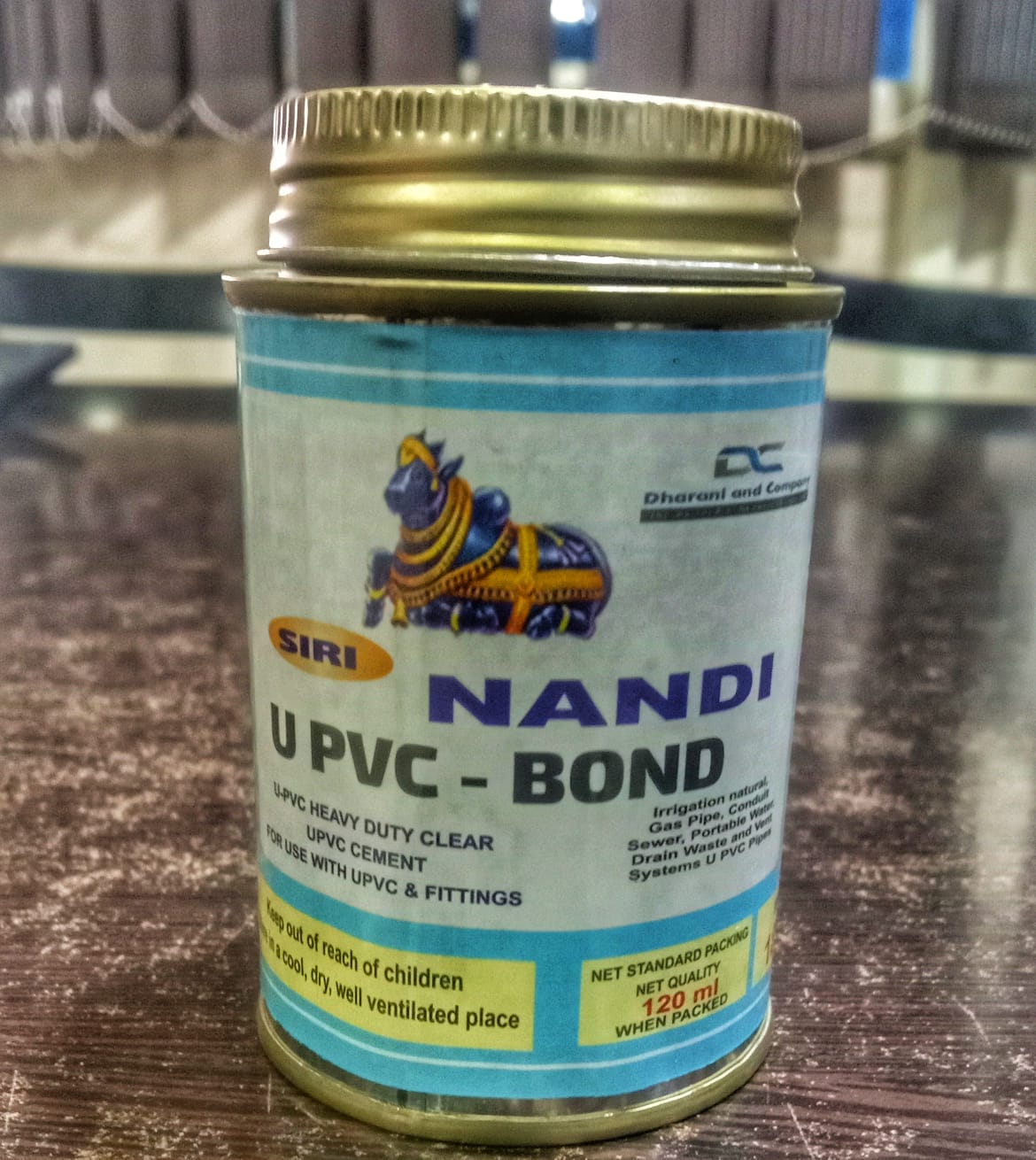 | UPVC SOLVEN CEMENT As a leading UPVC Solvent Cement manufacturer, we pride ourselves on delivering high-quality chemical solutions tailored to the specific needs of the... View product → |
Frequently asked questions
How does CPVC solvent cement create a fused pipe joint?
It softens and partially dissolves the mating CPVC surfaces, allowing polymer chains to intermingle before the softened zones harden.
What steps are included in the CPVC pipe bonding process?
The process includes measuring, square cutting, deburring, cleaning, dry-fitting, applying compatible cement, joining with a twist, and holding the assembly in place.
How do you inspect and test a CPVC solvent-bonded joint?
Inspect the bead, alignment, socket insertion, and visible gaps, then follow the cement manufacturer’s cure schedule before pressure testing.
When is solvent bonding a poor choice for CPVC pipe assembly?
Choose another joint method when the system needs regular disassembly, field adjustment, thermal movement management, or a connection to incompatible materials.
Keywords