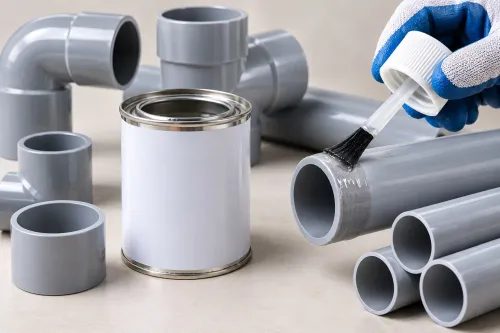
The right can size depends on more than the number printed on the label: you must match cement quantity to joint count, pipe diameter, application method and the product’s rated body class. By the end, you will be able to estimate your requirement, reject unsuitable formulations and prepare a purchase enquiry that a Bangalore supplier can answer accurately.
Key takeaways
- Match the cement label to your UPVC pipe and fitting diameter range.
- Choose pack size from joint count, pipe diameter, and application losses.
- Confirm the cement grade, batch number, shelf life, and technical data sheet.
- Allow joints to cure longer when Bangalore conditions are cool or humid.
What does UPVC solvent cement size actually mean?
“Size” has two meanings in UPVC solvent cement. It can mean the can’s net quantity—50 g, 100 g, 250 g, 500 g or 1 kg—or the pipe and fitting diameter range approved for that cement.
A 1 kg can is not automatically suitable for larger UPVC pipe; the cement’s body class, gap-filling ability and pressure-service limits control that decision.
Pack quantity is a purchasing decision about how much you will use, not proof of technical suitability.
| Pack category | Practical use | Main risk |
|---|---|---|
| Small repair pack | A few joints or maintenance work | Repeated opening can waste solvent and shorten usable life |
| Medium plumbing-work pack | Several fittings in a modest installation | Confirm quantity against the joint count and application rate |
| Large contractor or site pack | Many joints across a planned installation | Solvent loss, thickening and opened-pack waste if work is delayed |
These categories describe buying situations, not guaranteed stock sizes. Confirm the actual pack sizes available before purchase, and select a quantity you can use within the manufacturer’s stated open-pack working life. The same formulation may be sold in several quantities, while regular-, medium-, heavy- and extra-heavy-bodied products can have different approved diameters and pressure limits.
Your purchase specification must state both net quantity and approved pipe diameter range. When comparing upvc solvent cement size for bangalore, check the label or technical data sheet rather than choosing by can size, colour or price. The same approach applies to upvc solvent cement options bangalore: verify the grade first, then choose the pack.
How much cement will your fittings consume?
Estimate consumption by counting every solvent-welded socket joint, then recording each pipe’s outside diameter. For UPVC cement for pipe fittings, use the label or technical data sheet’s stated application rate, coverage guidance or consumption table; do not assume one joint has a universal gram value.
- List each joint by pipe outside diameter and fitting type.
- Apply the specified quantity for that joint, based on the stated application surfaces and method.
- Add the quantities together, then add a documented reserve for brush loading, spills, cleaning losses and cement left in an opened pack.
Joint circumference and socket depth change the coated area. Brush loading also changes how much cement reaches the joint, while the specified application surfaces determine whether you coat one component or both. These differences make averaging unlike joints unreliable.
Separate the estimate by diameter or body class instead. A large-diameter joint or a heavier-bodied product can consume far more than a small, regular-bodied joint, so choose UPVC solvent cement using the product’s own data rather than can size alone.
Several small repair cans create waste through repeated opening, leftover cement and batch handling. One large can creates waste when solvent evaporates, the cement thickens, or the whole batch is exposed during a few-joint repair.
Round up to the next available verified pack size only after checking unopened shelf life, storage conditions, open-pack working life and discard instructions. Do not treat old, stringy or gelled cement as usable.
Which UPVC cement grade fits the pipe system?
Choose UPVC solvent cement only after identifying the pipe system, not the can size. Confirm that both pipe and fittings are PVC-U/UPVC, not CPVC or ABS, and do not substitute a general-purpose adhesive. Follow the pipe and fitting manufacturer’s permitted cement type for the joint.
Viscosity and gap-filling capacity must match the pipe outside diameter, schedule or pressure class, and service. For UPVC cement for pipe fittings, use the manufacturer’s stated body class and diameter limits:
| Option | Selection basis | Risk of choosing incorrectly |
|---|---|---|
| Regular-bodied | Small-diameter, close-fitting joints within the approved range | Poor gap filling on larger or looser sockets |
| Medium-bodied | Moderate diameters and service conditions within the data sheet limits | Incomplete wetting or weak coverage |
| Heavy-bodied | Larger diameters, wider gaps or higher-duty joints when specified | Excess cement, slow solvent release or unsuitable fit |
| Extra-heavy-bodied | Large, demanding joints only when the manufacturer permits it | Difficult assembly and unreliable curing on small pipe |
Ask for ASTM D2564 applicability, or the specific standard named on the technical data sheet. Do not choose by colour, apparent thickness or can size.
Treat primer as a separate decision. Verify whether the system requires purple or clear primer, whether it is supplied separately, and whether the project specification mandates it. For drinking-water work, request cement and primer approval such as NSF/ANSI/CAN 61 where specified. For chemical service, check compatibility with the actual fluid and operating temperature.
A larger container cannot correct an unsuitable grade.
How should you apply and cure the cement in Bangalore conditions?
1. Cut the pipe square, deburr the edge, and dry-fit it to confirm full insertion depth. A shallow fit, burr or forced joint can cause leaks and consume extra cement during rework.
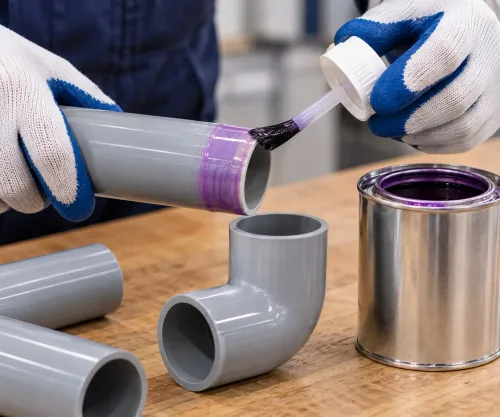
2. Clean the pipe and socket thoroughly, then keep both surfaces dry and oil-free. Remove dust, condensation and rainwater before assembly; postpone the joint if you cannot protect it from moisture. Use primer in this sequence when the selected cement system or project specification requires purple or clear primer.
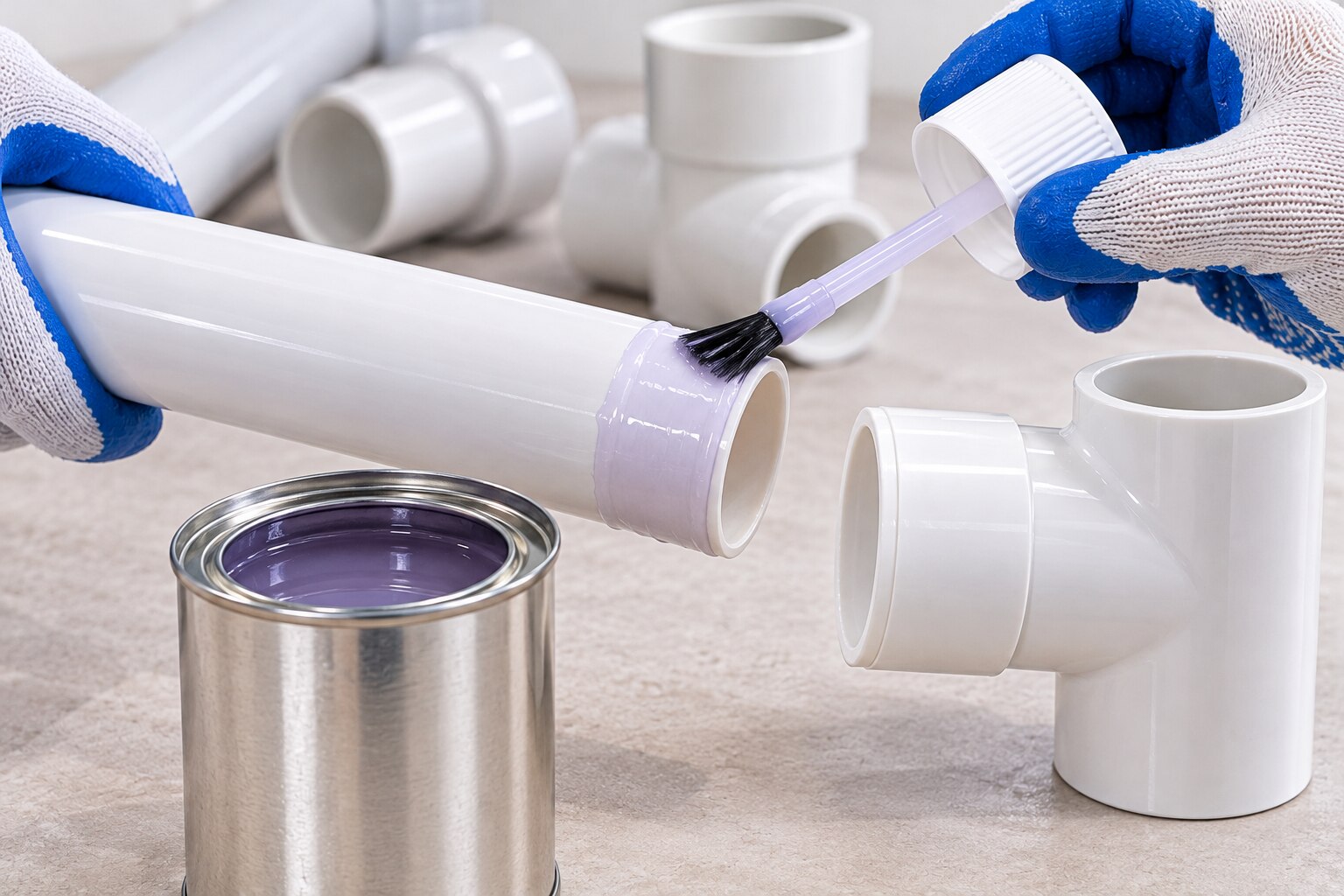
3. Apply cement evenly to the specified surfaces, without using it to fill a large gap. Push the pipe fully home with a twist, hold the joint in position, and remove excess cement. Work quickly within the product’s stated open and assembly times.
4. Bangalore’s monsoon humidity increases condensation risk, while hot sites can accelerate solvent loss and thickening. Keep cans closed and protected from heat and moisture, ventilate the work area, and remove flames, sparks and other ignition sources.
5. Use the product label or technical data sheet for open time, assembly time, handling time, and pressure-test or service-entry time. Larger diameters, wet conditions and cooler conditions can lengthen curing, so a firm-feeling joint does not prove that a pressure line is ready.
6. For your UPVC solvent cement size for Bangalore decision, estimate cement from the actual joint count, diameter and documented application rate, then add a recorded reserve for brush loading, spills, cleaning and opened-pack loss. Do not select a larger can as a substitute for correct drying or curing.
What should you ask a UPVC solvent cement supplier in Bangalore?
Ask for documents and batch details before you compare cans; “UPVC cement” alone does not tell a supplier which formulation or volume fits your work.
- Product name and PVC-U/UPVC compatibility; exclude CPVC, ABS and general-purpose adhesive.
- Approved pipe outside-diameter range, body class, net volume and current pack size.
- Batch or lot number, manufacture date, expiry date or unopened shelf life, and storage temperature.
- Hazard symbols, safety data sheet and manufacturer contact details.
- Technical data sheet, ASTM D2564 reference or another printed standard, primer requirement, application method and cure chart.
- Potable-water approval, such as NSF/ANSI/CAN 61 where specified, or chemical-service approval for your actual fluid and temperature.
Send this enquiry: “PVC-U pipe, outside diameter mm, schedule/class , pressure or non-pressure service, potable-water: yes/no, primer required: yes/no, Bangalore site conditions , total socket joints . Please recommend the body class and pack quantity, and send the TDS, SDS, approvals and batch details.”
A search for an upvc solvent cement supplier bangalore becomes useful when the supplier verifies formulation, current pack volumes, documents and stock batch. Dharani and Company is useful on that basis, not because it offers the largest can.
| Option | Compare on | Avoid |
|---|---|---|
| Small repair pack | Few joints, less opened-pack loss | Repeated opening across a large job |
| Medium plumbing pack | Routine fitting work | Buying without consumption data |
| Large site pack | Many matching joints | Solvent loss, thickening or old stock |
Compare upvc solvent cement options bangalore on technical fit, usable quantity, document quality and storage history—not delivery distance or price alone.
Related product
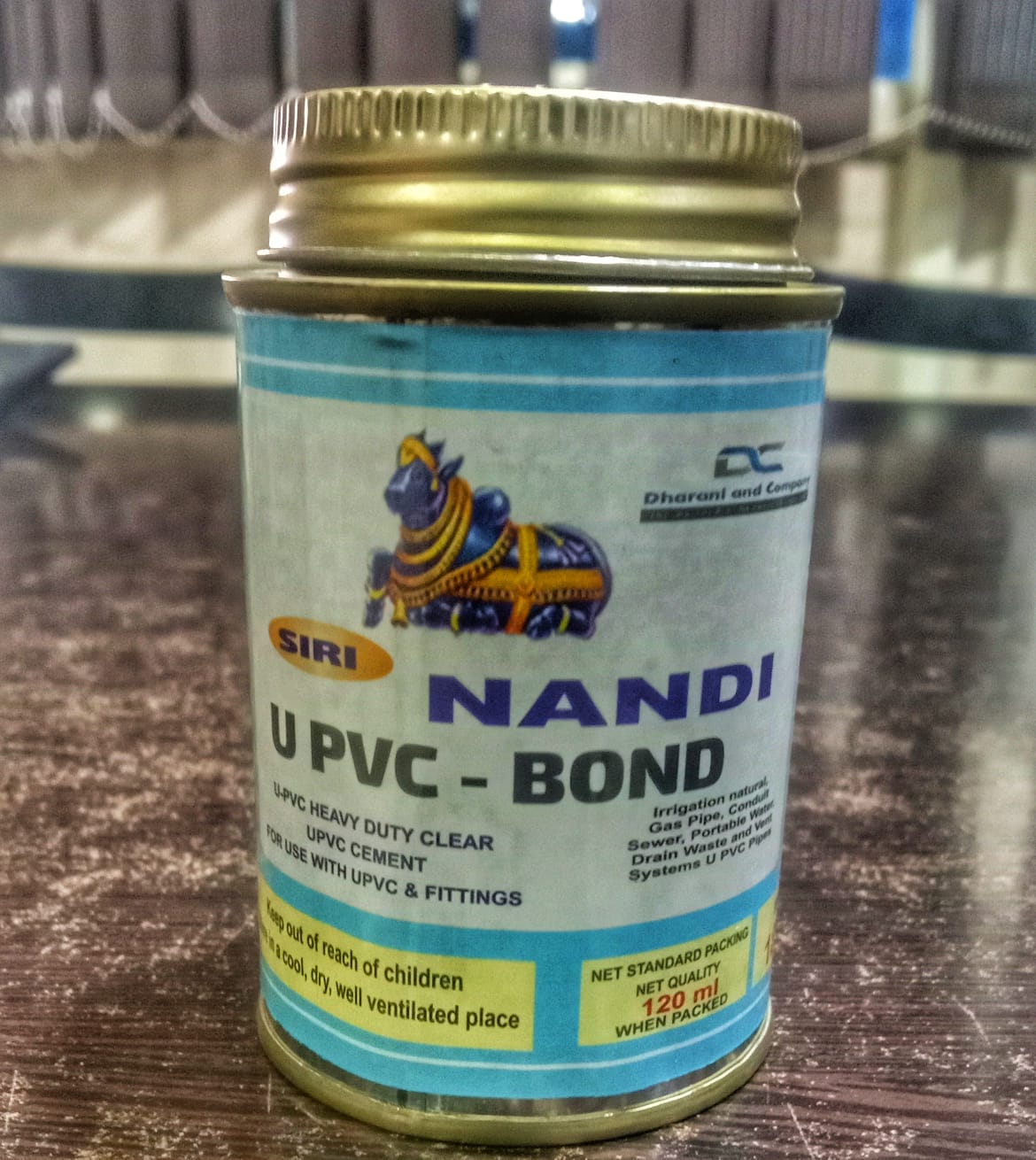 | UPVC SOLVEN CEMENT As a leading UPVC Solvent Cement manufacturer, we pride ourselves on delivering high-quality chemical solutions tailored to the specific needs of the... View product → |
Frequently asked questions
What does UPVC solvent cement size mean?
It refers to both the can’s net quantity, such as 50 g or 500 g, and the pipe-and-fitting diameter range stated on the label.
How much UPVC solvent cement will pipe fittings consume?
Consumption depends on pipe diameter, joint count, socket depth, application thickness, and waste. Count the joints and compare them with the supplier’s coverage guidance.
Which UPVC cement grade fits a pipe system?
Choose a grade whose label or technical data sheet names your UPVC pipe material, fitting type, and diameter range. Do not select by can size alone.
How should you apply and cure UPVC solvent cement in Bangalore?
Clean and dry both surfaces, apply cement evenly to the pipe and socket, assemble immediately with a twist, and protect the joint during curing. Follow the product’s temperature and cure-time instructions.
What should you ask a UPVC solvent cement supplier in Bangalore?
Ask for the recommended pipe diameter range, compatible UPVC standards, technical data sheet, batch number, manufacture date, shelf life, storage instructions, and coverage guidance.
Keywords