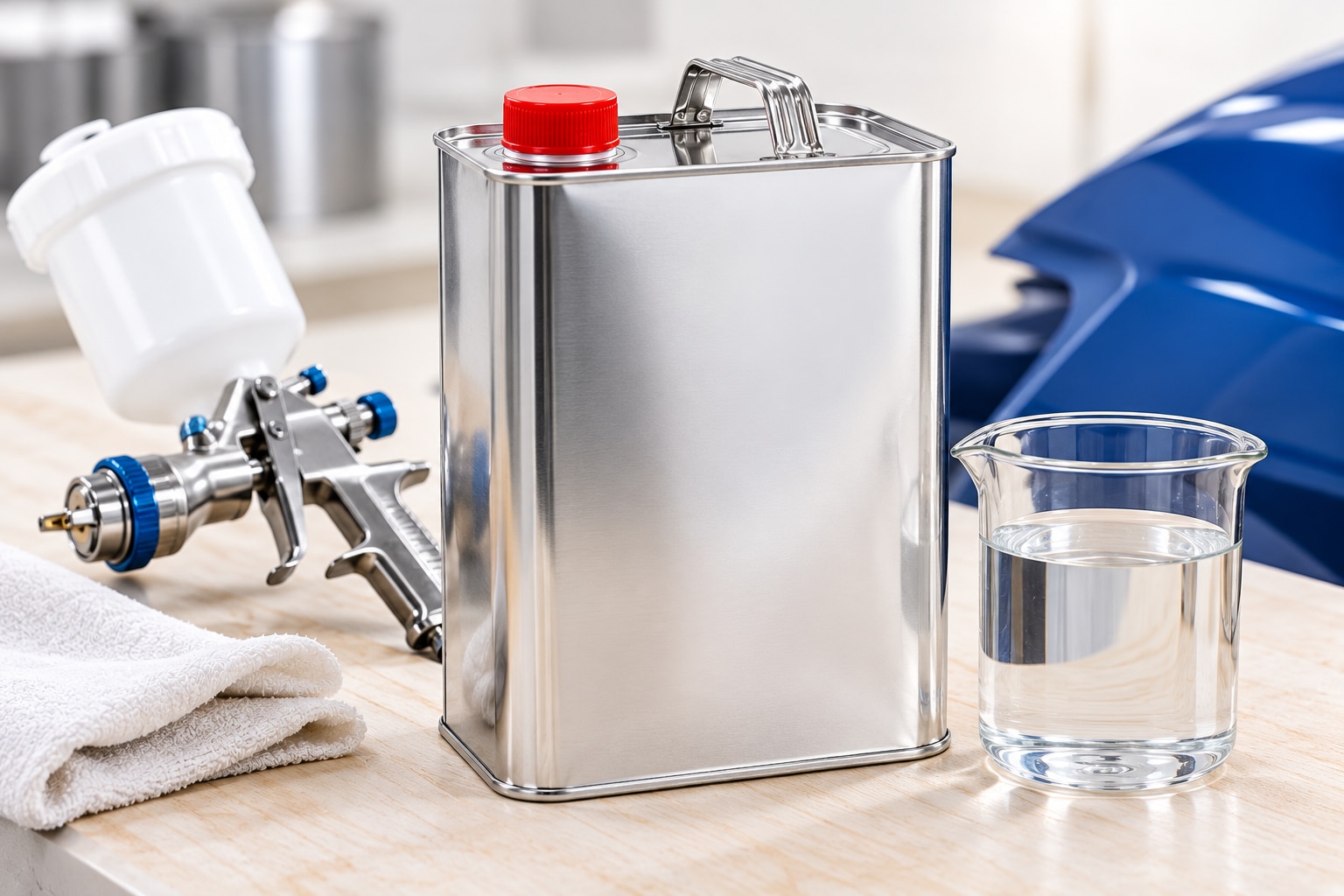
Adding NC thinner changes more than the ease of spraying: it alters viscosity, solvent balance, solids content, drying behaviour and final film quality. By the end, you will be able to set a controlled addition sequence, measure the result, recognise incompatible resin systems and compare thinner blends before approving them for production or spray-booth use.
Key takeaways
- Add NC thinner after dissolving nitrocellulose and establishing the resin solution.
- Calculate thinner against batch weight and target viscosity, not by guesswork.
- Balance evaporation rates to reduce orange peel, blushing, and gloss loss.
- Approve each blend with viscosity, drying, appearance, and compatibility tests.
How NC Thinner Changes Viscosity, Flow and Film Formation
Adding NC thinner lowers the paint’s viscosity by increasing the distance between resin, pigment and other solids. The binder amount does not increase, so excessive thinner reduces solids by volume, dry-film thickness and often gloss.
Flow and levelling improve until the coating becomes too fluid, while faster solvent loss can shorten open time and drying time.
For anyone asking what happens when NC thinner is used in paint production Bangalore, the answer depends on the resin, solvent blend, spray gun and application temperature. Too little thinner causes poor atomisation, orange peel, dry spray and excessive film build. Too much causes runs, weak coverage and solvent entrapment.
Measure viscosity at a defined temperature with the same Ford cup, Zahn cup or rheometer; a temperature change can produce a misleading result.
| Paint system | NC thinner response | Decision |
|---|---|---|
| Nitrocellulose lacquer | Dissolves or reduces the compatible NC binder system and adjusts spray viscosity | Use a validated blend |
| NC-modified solventborne lacquer | Can work when the resin supplier confirms solvent compatibility | Run a drawdown and spray test |
| Water-based paint | NC thinner disrupts the water-resin balance and can cause coagulation or separation | Do not use |
| Polyurethane or epoxy | Can damage cure, pot life, adhesion or gloss | Do not substitute without a documented formulation approval |
| Acrylic or other solventborne resin | Compatibility varies by resin chemistry and solvent demand | Approve only after testing |
Add thinner in measured portions rather than pouring by eye. Confirm viscosity, spray pattern, levelling, drying and final film thickness before releasing the batch. A replacement blend requires a safety data sheet, technical data sheet, batch certificate and application test.
The Correct NC Thinner Sequence for Nitrocellulose Lacquer
Charge only part of the solvent at the start. This gives the resin enough solvent strength to dissolve cleanly; adding the entire thinner charge too early can weaken solvency and make pigment dispersion harder to control.
1. Confirm that the binder package is intended for nitrocellulose lacquer, then weigh the resin, nitrocellulose grade, plasticizer and pigments. Record the batch numbers and measure the starting viscosity.
2. Charge the initial solvent portion into a closed, grounded mixing vessel. Start agitation before adding resin, then mix until the resin solution is clear and free of gel particles.
3. Add plasticizer and other nonvolatile additives slowly. Check for haze or precipitation before proceeding; an NC thinner that suits nitrocellulose can still destabilize an alkyd, acrylic or modified resin.
4. Add wetted-grade nitrocellulose gradually, never dry powder into the vessel. Maintain enough agitation to prevent fish-eyes, lumps and local over-concentration.
5. Disperse pigments, if the formula contains them, until the required fineness and uniformity are reached. Keep the vessel covered and control ignition sources because the solvent vapour is highly flammable.
6. Add the remaining NC thinner in measured portions. Mix after each portion, recheck viscosity, and stop at the formula target rather than pouring until the lacquer “looks right.”
7. Run a spray panel or drawdown, then filter the approved batch through the specified mesh before filling. Inspect the filtered lacquer for sediment, gel particles, haze and colour variation.
This sequence is the practical basis for nc thinner paint production steps bangalore facilities can document and repeat. Use closed transfer, bonding and grounding, ventilation, and compatible containers throughout.
How to Calculate the Addition Without Losing Solids
Calculate NC thinner against a defined batch basis, not by pouring until the paint “looks right.” For a batch, use:
NC thinner addition, % by weight = thinner mass ÷ batch mass before addition × 100
If the target is 5% on a 100 kg pre-thinner batch, add 5 kg. Record the basis clearly; 5% of the pre-addition batch is not the same as 5% of the final 105 kg batch.
- Weigh resin, pigments, plasticizer and manufacturing solvent separately, then record each material, lot number and actual mass in the batch sheet.
- Measure viscosity at a fixed temperature, such as 25°C, using the specified Ford cup, Zahn cup or rheometer method.
- Add the approved NC thinner in weighed portions, mix for the defined time, and record the cumulative mass.
- Recheck viscosity at the same temperature and method. Confirm solids by volume or weight from the formulation calculation, because thinner adds mass and volume but no binder.
- Spray a test panel using the production gun, nozzle, pressure and film thickness. Check atomisation, flow, dry-film build, gloss and drying.
Keep manufacturing solvent inside the formulation and batch solids calculation. Record thinner added at the spray booth in a separate application log; it changes application viscosity and VOC consumption but must not be counted as paint-production solvent.
A sound record of nc thinner usage for paint businesses includes batch number, supplier and lot, kilograms or litres, density, addition stage, viscosity result and test-panel approval. Revalidate the range after changing resin, thinner blend, equipment or climate.
How Evaporation Balance Controls Orange Peel, Blushing and Gloss
A balanced evaporation curve controls whether an NC lacquer levels into a glossy film or freezes with texture. Fast solvent lowers viscosity and dries the surface quickly; slow solvent preserves flow long enough for levelling, but too much leaves the film soft and traps solvent.
| Evaporation rate | Application effect | Typical failure when unbalanced |
|---|---|---|
| Fast | Quick flash-off and early surface dry | Orange peel, dry spray, poor gloss, and solvent pop under heavy wet films |
| Medium | Maintains workable open time and supports levelling | Uneven gloss when the blend cannot match spray pressure, film thickness, or substrate temperature |
| Slow or retarder | Reduces evaporative cooling and extends flow | Slow drying, solvent entrapment, blocking, or print formation when overused |
High Bangalore humidity makes fast evaporation riskier. Evaporative cooling can lower the wet-film temperature to the dew point, allowing moisture to condense inside the lacquer and scatter light as a milky blush. Measure air temperature, relative humidity, dew-point margin, airflow, and substrate temperature at mixing and spraying; the city label alone predicts nothing.
In hot, dry conditions, excessive airflow strips fast solvent before the film levels, creating orange peel and dry spray. In humid monsoon conditions, reduce the evaporation shock through controlled ventilation, adequate flash-off, and a compatible retarder rather than simply adding more thinner.
Keep wet-film thickness controlled: a fast blend beneath a heavy coat can cause solvent pop, while an overly slow blend can reduce early hardness and gloss. Test the actual blend by spray panel before release.
How to Approve an NC Thinner Blend for Production
Approve a replacement blend only after it passes document review, laboratory checks and a spray trial on your actual lacquer. The label “NC thinner” does not prove suitability. If you are comparing NC thinner manufacturing in Bangalore, ask Dharani and Company—or any supplier—for the same evidence.
Request these records before accepting a batch:
- Current safety data sheet, technical data sheet, batch certificate and declared solvent identities.
- Density or specific gravity, water content where relevant, appearance, nonvolatile residue and distillation or evaporation profile.
- Recommended storage temperature, container material, flash point and handling controls.
- A reference-lacquer result showing viscosity reduction at a stated temperature, test method and dosage.
Use this acceptance screen:
| Check | Pass condition | Reject if |
|---|---|---|
| Composition | Fast and medium solvents, plus retarder when validated for the resin and climate | Solvent identity is undisclosed or differs from the approved formula |
| Quality | Clear liquid; batch values match specification; no excess water or residue | Haze, sediment, abnormal odour or failed evaporation profile |
| Compatibility | No gel, precipitation, colour change or viscosity drift after sealed storage | Lacquer separates or thickens during the storage test |
| Safety | Bonded and grounded transfer, closed containers, ventilation and ignition control are documented | Open transfer, unsuitable packaging or uncontrolled ignition sources |
| Application | Reference spray or drawdown meets viscosity, flow, gloss and blush targets | Orange peel, whitening, poor levelling or excessive dry spray |
Run the trial at recorded temperature, relative humidity, dew-point margin, ventilation and substrate temperature. Compare against the approved thinner using the same equipment and measurement method.
Frequently asked questions
How does NC thinner change paint viscosity and film formation?
NC thinner lowers viscosity by spacing resin, pigment, and other solids. Excess addition reduces solids by volume, dry-film thickness, and often gloss.
What is the correct NC thinner sequence for nitrocellulose lacquer?
Dissolve the nitrocellulose and establish the binder solution first, then add the thinner blend gradually while mixing and checking viscosity.
How do you calculate NC thinner addition without losing solids?
Calculate the required addition from the batch weight, current viscosity, target viscosity, and measured solids. Do not rely on a fixed percentage for every formulation.
How does evaporation balance affect orange peel, blushing, and gloss?
A blend that evaporates too quickly can cause poor flow and orange peel; excessive cooling during evaporation can cause blushing. Balanced evaporation supports smoother films and consistent gloss.
How do you approve an NC thinner blend for production?
Test viscosity, drying time, spray appearance, gloss, film adhesion, solids, and compatibility on the intended lacquer before releasing the blend for production.
Keywords